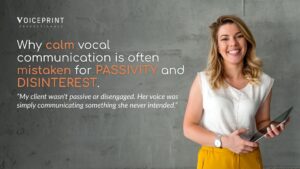

Is your voice undermining your vocal confidence?
You might have the skills, the knowledge, and the experience, but if your voice tells a different story - one of hesitation or uncertainty - it can quietly undermine your vocal confidence and the message people remember.
In my work with clients, I’ve consistently observed this: brilliant professionals whose vocal habits are unintentionally sending mixed messages. The result? Missed opportunities, misunderstood ideas, and an invisible barrier between them and the impact they could be having.
Let’s talk about the habits that subtly undermine vocal confidence and what you can do about them.
Common vocal habits that undermine vocal confidence
Here are six frequent (and totally fixable) culprits:
- Upspeak
When you inflect your pitch upwards at the end of a statement it sounds like question. Example: “I lead the marketing team?” It suggests uncertainty, even when you’re confident in your role. - Vocal fry
That low, gravelly tone at the end of sentences. It can sound disinterested, unenergetic, or disengaged – not the tone most people want associated with their message. - Breathy or uncertain delivery
When your voice lacks power or trails off. This signals nervousness and can make listeners question your conviction, even when your content is strong. - Undermining language
Words like “just”, “maybe”, “I think” – often used to soften our message, but they also soften our authority. - Filler Words
Words like “um”, “ah”, “like”, “you know” distract from your message and suggests lack of preparation or confidence in the content. - Laughter Padding
Nervous laughter, often being added in-between words, minimises the seriousness of your words and can make you appear unsure.
The good news? These are all habits – not personality traits. And habits can change.
With the right awareness and tools, you can strengthen your vocal confidence and:
- Sound more grounded and assured
- Communicate your ideas with clarity and impact
- Shift how others perceive your confidence – and how you feel in the moment
Ready to strengthen your vocal presence?
At VoicePrint Professionals, we help professionals become more intentional, flexible, and effective with their voice – whether they’re leading meetings, delivering presentations, or simply wanting to be heard more clearly.
Curious how these habits might be showing up in your voice? Join us for The Confident Communicator – a free, online, practical workshop to help you speak with clarity and impact.
Your voice has power. Let’s make sure it’s working for you.