

How Vocal Communication Shapes Perception in Meetings
A small change in your voice can create a significant change in your impact.
When you speak in a meeting, people are not only listening to your ideas.
They are also responding to your voice.
Before your message is fully analysed, subtle vocal signals begin shaping how others interpret what you say. Your tone, pace, pauses and intonation can influence whether your message sounds confident, collaborative, reassuring or uncertain. This is why vocal communication plays such a critical role in professional environments.
Many professionals spend years developing expertise in their field, yet overlook one of the most influential tools they possess: their voice as a leadership communication tool. Research shows us that people form impressions about credibility, trustworthiness and authority within moments of hearing someone speak.
Why Your Voice Influences First Impressions
Research consistently shows that people react to the sound of a voice at a subconscious level. Long before they have fully evaluated the content of a message, they are already making assumptions based on vocal cues.
From the sound of your voice, listeners unconsciously assess:
- Confidence and authority
- Trustworthiness
- Professional competence
- Emotional state
- Leadership potential
This is one reason why effective vocal communication can have a significant impact on workplace outcomes. Whether you are presenting to clients, leading a team meeting or contributing ideas during a discussion, your voice influences how your message is received.
The good news is that vocal skills can be developed. Like any professional skill, greater awareness and practice can lead to noticeable improvements.
The Role of Intonation In Meetings
One of the most important elements of vocal delivery is intonation – the pattern of pitch variation in speech.
Intonation helps communicate meaning beyond the words themselves. A sentence delivered with rising pitch may sound uncertain or inquisitive, while a controlled downward inflection can communicate confidence and certainty.
In meetings, intonation can affect whether your message sounds:
- Inspiring or flat
- Confident or hesitant
- Collaborative or confrontational
- Calm or anxious
This does not mean you should perform or act. Instead, the goal is to ensure that your vocal delivery supports your intended message.
For example, when presenting a new initiative to a team, a dynamic and engaging vocal style can create enthusiasm and encourage participation. During challenging conversations, a steady and controlled vocal tone can help project calm leadership and stability.
4 Simple Tips To Improve Your Vocal Communication
Improving vocal communication does not require dramatic changes. Small adjustments can significantly influence how others perceive your confidence, credibility and leadership presence.
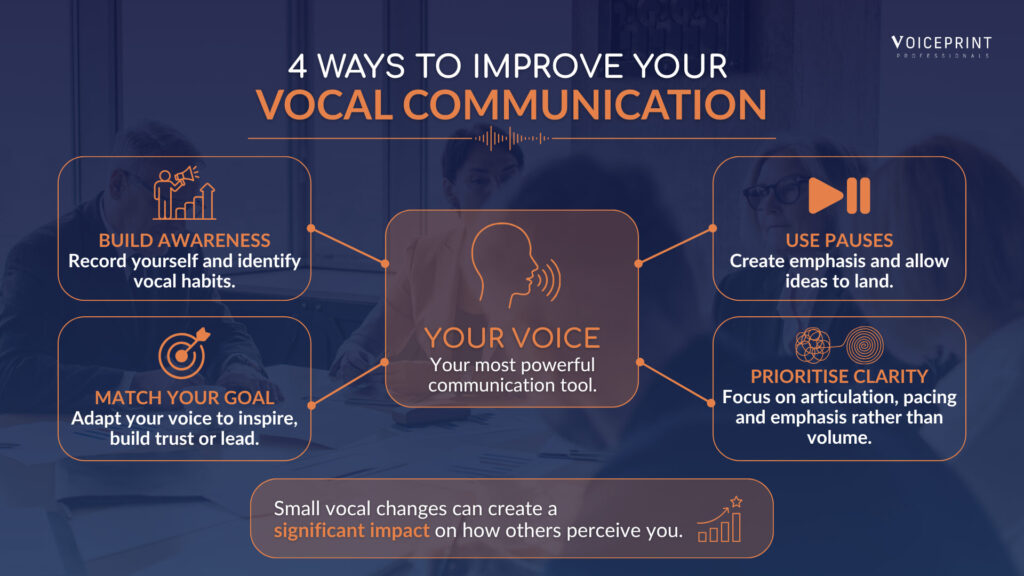
- Build Vocal Awareness
Most people have little awareness of how they sound to others. Recording yourself during presentations or practice sessions can reveal habits you may not notice in real time. You may discover that you speak too quickly, use limited vocal variation or finish important statements with an upward inflection. - Use Purposeful Pauses
Many professionals rush through key messages. Strategic pauses create emphasis, allow important points to land and project greater confidence. They also provide listeners with time to process information. - Match Your Voice to Your Objective
Different situations require different vocal approaches. If your goal is to inspire, greater vocal variety and energy will be beneficial. If your goal is to build trust and rapport, a more conversational and collaborative tone may be appropriate. Effective speakers develop vocal flexibility, enabling them to adapt their delivery according to the outcome they want to achieve. - Focus on Clarity Rather Than Volume
Speaking louder does not necessarily increase authority. Clear articulation, controlled pacing and purposeful emphasis often have a greater impact than simply raising your volume. The strongest communicators know how to use their voice strategically rather than forcefully.
Why Vocal Communication Matters For Leaders
Leadership is not only about expertise or decision-making. It is also about influencing, guiding and connecting with people.
Leaders who understand the power of vocal communication are often better positioned to build trust, create engagement and communicate their intentions clearly.
When team members feel confident in a leader’s message, they are more likely to listen, respond positively and take action. Conversely, when vocal delivery unintentionally signals uncertainty or tension, even strong ideas can lose impact.
This is why voice development is increasingly recognised as an important component of leadership and professional communication training.
Your voice is more than a vehicle for delivering information. It is a powerful communication tool that shapes how your ideas are interpreted, remembered and acted upon.
By developing greater awareness of your tone, intonation, pacing and delivery, you can strengthen your vocal communication and significantly increase your professional impact. Small changes in how you use your voice can transform how others perceive your message.
Ready to Increase Your Impact?
If you’d like to better understand how your voice influences others, explore our Corporate Training Programs, or contact us to discover practical, science-based strategies for improving vocal influence and professional communication.