

Why Delivery Matters in Leadership Communication
In business communication, we spend a lot of time getting the content right.
We write, revise, and polish every sentence to ensure our message is clear, strategic, and aligned with our goals. We carefully choose our words, refine our key points, and think about how our audience will respond.
But there’s one critical element of leadership communication that is often overlooked: how the message is delivered.
While content matters, the way we use our voice can have an even greater impact on how our message is received. Tone of voice, pacing, breath control, and vocal presence are not simply presentation skills. They are powerful communication tools that influence how people perceive us, whether they trust us, and how effectively our ideas gain traction.
The Hidden Influence of Voice in Leadership Communication
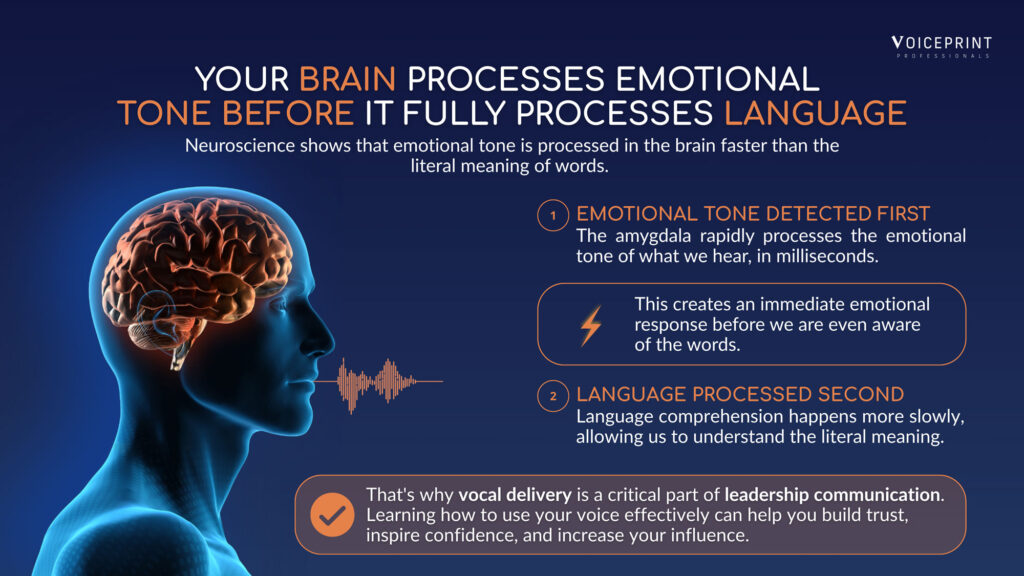
Research in neuroscience shows that our brains process emotional tone before we fully process language. In other words, people are responding to how you sound before they are consciously evaluating what you are saying.
This means that by the time your audience has understood your words, your vocal delivery has already shaped their perception of you.
Your voice can communicate confidence, authority, trustworthiness, collaboration, warmth, or uncertainty – often without either party being fully aware of it. Whether you are presenting to a boardroom, leading a team meeting, negotiating with a client, or having a difficult conversation, your voice is constantly sending signals.
This is why effective leadership communication requires more than well-crafted messaging. It requires awareness of the vocal behaviours that support your message and reinforce your intentions.
Why Great Leaders Focus on Presence, Not Just Content
Many professionals assume that if they have expertise and strong ideas, people will naturally listen.
Unfortunately, communication does not work that way.
People are more likely to engage with a message when the speaker sounds calm, credible, and authentic. A rushed pace, strained tone, or breathless delivery can unintentionally undermine even the strongest content.
The most influential leaders understand that communication is an experience, not just an exchange of information.
When people listen to you, they are not only processing your words. They are also responding to your energy, emotional state, and vocal presence.
This is why developing vocal awareness can become a significant professional advantage. It helps ensure that your delivery supports your message rather than competing with it.
If you’re interested in developing greater vocal impact, explore our voice training programs or learn more about our communication coaching services.
A Simple Technique Before Important Conversations
One of the most powerful practices we teach our clients is surprisingly simple.
Before an important conversation, pause and reset.
Whether you’re preparing for a leadership presentation, a challenging team discussion, a sales meeting, or a client pitch, take just 30 seconds to ground yourself.
Ask yourself:
- Am I feeling rushed?
- Am I holding tension in my body or breath?
- Am I distracted or mentally elsewhere?
- How do I want people to experience me in this conversation?
Next, practise your opening sentence out loud.
Not to memorise it. Not to sound rehearsed.
Instead, focus on delivering it with calm, grounded intention.
This small adjustment helps align your voice with the message you want to communicate rather than the stress or pressure of the moment.
The result is often immediate. People listen differently. They feel more at ease. They perceive greater confidence and credibility.
The Voice as a Strategic Leadership Tool
When communication breaks down, it is rarely just because of the words being used.
More often, it is the experience of hearing those words that creates misunderstanding, resistance, or disengagement.
Strong communicators do not simply lead with logic. They lead with presence.
Their voice helps create trust, establish authority, build rapport, and encourage collaboration. They understand that vocal delivery is not separate from communication – it is communication.
Developing greater vocal flexibility and awareness allows leaders to adapt their communication style to different situations and outcomes. Sometimes the goal is to inspire. Other times it is to reassure, influence, collaborate, or take decisive action.
Your voice can support every one of these objectives when you know how to use it effectively.
Effective leadership communication is about far more than choosing the right words. It is about ensuring your voice reinforces your message, your intentions, and your leadership presence.
The next time you prepare for an important conversation, spend as much attention on how you will deliver your message as you do on what you will say.
Your voice may be one of the most powerful leadership tools you have – and one of the most underutilised.
Ready to Strengthen Your Leadership Communication?
Discover how voice and vocal communication training can help you build trust, increase influence, and communicate with greater impact.
Explore our training programs, join one of our free webinars, or contact us to learn how we can help you unlock the full potential of your voice.